
The Convergence of Two Revolutionary Technologies
In 2025, we stand at the intersection of two transformative forces: artificial intelligence and cryptocurrency. As Bitcoin hovers around $64,000 and Ethereum trades near $1,850, a new dynamic is emerging—one where AI is fundamentally altering how digital assets are traded, analyzed, and valued.
Bitcoin Market Performance (2021-2026)
To understand the current state of digital assets, we must look at the broader market trends over the past five years:
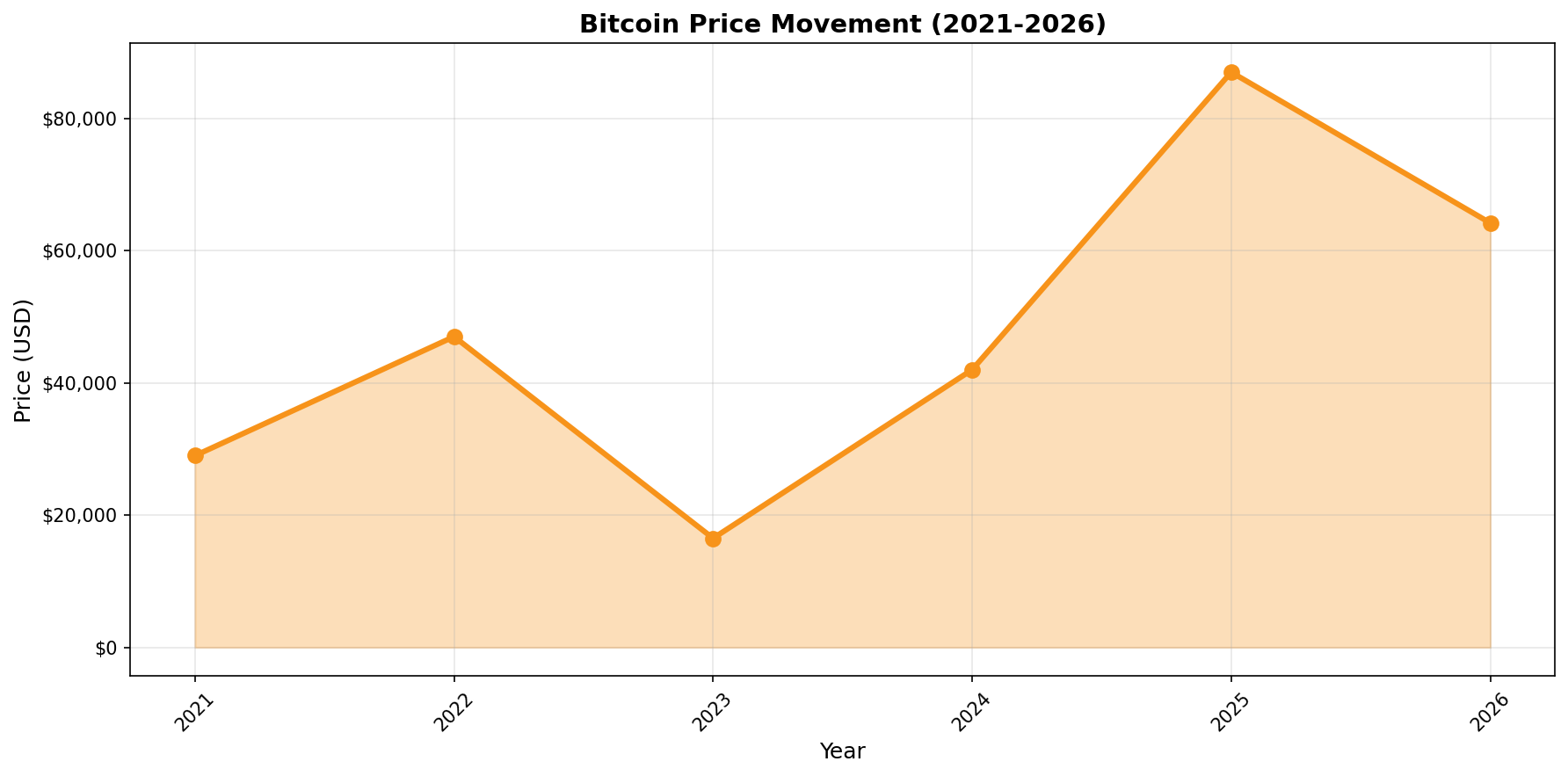
The chart above illustrates Bitcoin’s volatile journey from the 2021 bull run through the 2022-2023 bear market, followed by recovery and new all-time highs in 2024-2025. This price action provides crucial context for understanding how capital flows between traditional crypto investments and emerging AI-related assets.
VC Funding: The Capital Shift from Crypto to AI
Perhaps the most telling indicator of market sentiment is venture capital funding patterns. Over the past five years, we’ve witnessed a dramatic reallocation of institutional investment:
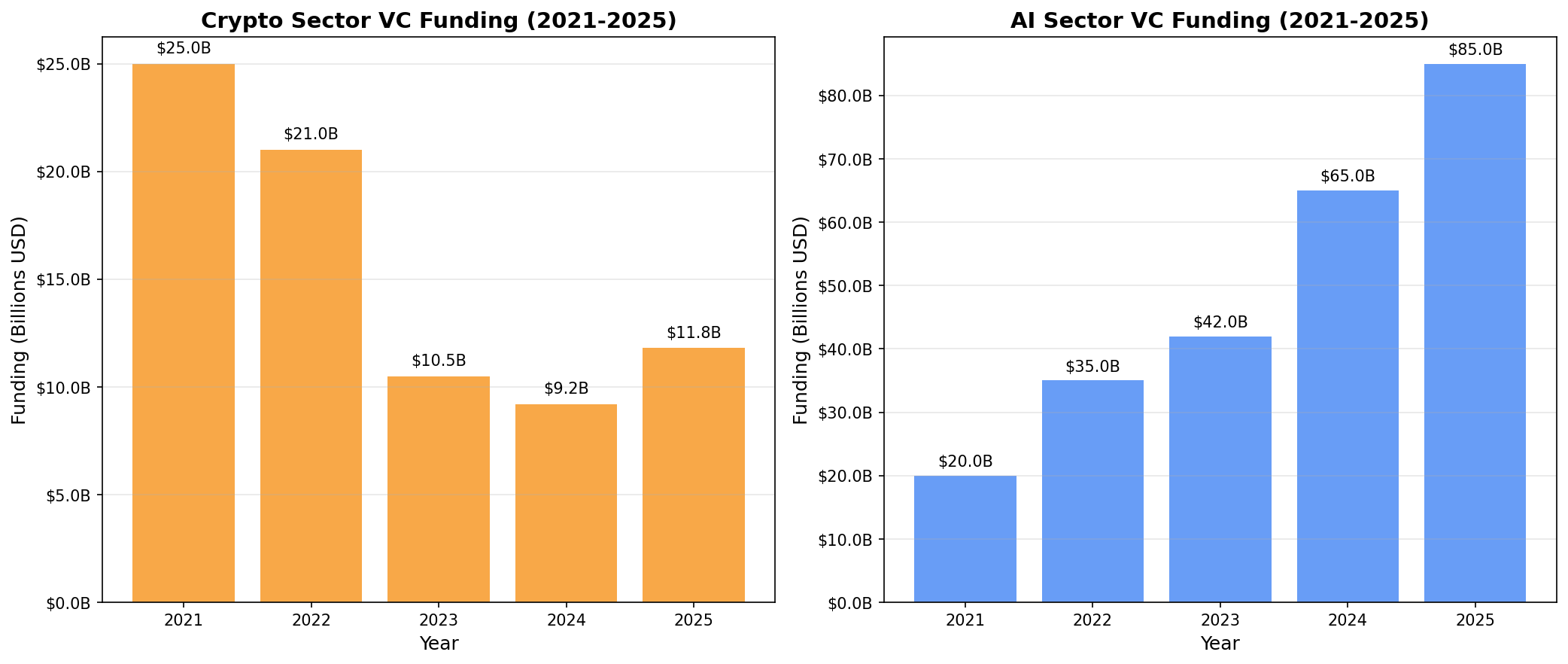
Crypto Sector Funding Collapse
The cryptocurrency sector experienced a severe funding drought:
- 2021: $25B peak funding during the bull market euphoria
- 2022: $21B maintained despite market downturn
- 2023: $10.5B (58% decline) – post-FTX collapse caution
- 2024: $9.2B (continued decline) – Bitcoin ETF approval didn’t revive VC interest
- 2025: $11.8B (modest recovery) – AI-crypto convergence narratives emerging
AI Sector Funding Explosion
Meanwhile, artificial intelligence attracted unprecedented investment:
- 2021: $20B baseline funding
- 2022: $35B (75% increase) – ChatGPT and LLM breakthroughs
- 2023: $42B (20% increase) – Enterprise AI adoption accelerates
- 2024: $65B (55% increase) – Multi-modal models and AI agents
- 2025: $85B (31% increase) – Agentic AI and reasoning models
The Crossover Point (2023-2024)
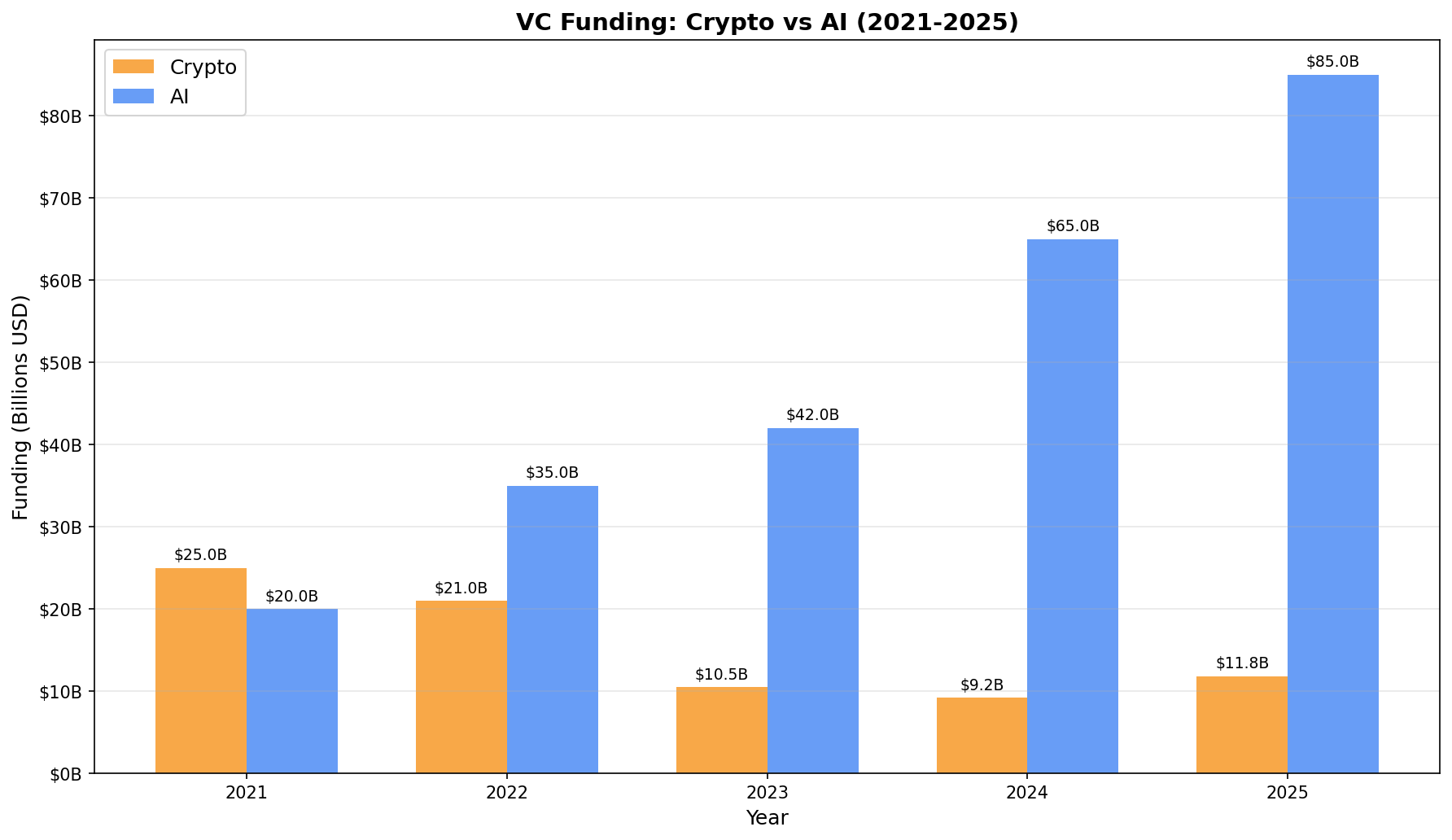
By 2023, AI funding had quadrupled from 2021 levels while crypto funding had collapsed by nearly 60%. This divergence represents more than just market cycles—it signals a fundamental shift in how investors view technological risk and opportunity.
However, 2025 tells a more nuanced story. While AI funding continues to grow, crypto has shown signs of stabilization and modest recovery. This suggests the markets may be entering a new phase: integration rather than competition.
AI-Powered Trading: The New Market Makers
Algorithmic trading has existed for decades, but the integration of large language models (LLMs) and machine learning into crypto markets represents a paradigm shift. AI systems now analyze on-chain data, social sentiment, and macroeconomic indicators in real-time, executing trades at speeds and scales impossible for human traders.
This has led to:
- Increased volatility: AI agents react instantly to news, creating rapid price swings
- Market efficiency: Arbitrage opportunities vanish in milliseconds as algorithms compete
- New patterns: Correlations between AI sentiment and price movements are becoming predictable
The Rise of AI Agents in DeFi
Beyond trading, autonomous AI agents are now managing DeFi protocols, optimizing yield farming strategies, and even participating in governance decisions. These agents can:
- Monitor hundreds of protocols simultaneously
- Automatically rebalance portfolios based on risk parameters
- Execute complex multi-step transactions across chains
This automation is democratizing access to sophisticated financial strategies previously reserved for institutional investors.
AI Tokens: A New Asset Class
The market has responded by creating an entirely new category: AI tokens. Projects combining blockchain with artificial intelligence—whether for compute marketplaces, data verification, or AI model governance—have attracted billions in investment.
However, this new asset class comes with unique risks. Many “AI tokens” offer little more than marketing hype, while others represent genuine technological innovation. Distinguishing between the two requires understanding both AI capabilities and blockchain fundamentals.
Sentiment Analysis at Scale
Perhaps the most immediate impact is in market sentiment. AI systems now monitor:
- Social media platforms for crypto discussions
- On-chain metrics like wallet activity and exchange flows
- News sources and regulatory announcements
- GitHub activity for development progress
This real-time analysis creates feedback loops where AI-detected sentiment shifts trigger algorithmic trading, which in turn influences sentiment—a self-reinforcing cycle that amplifies both bull and bear markets.
Current Market Snapshot
As of February 24, 2026:
- Bitcoin (BTC): $64,190, down 0.96% in 24 hours
- Ethereum (ETH): $1,850.73, down 0.71% in 24 hours
These relatively modest movements mask significant underlying activity, as AI-driven trading systems process terabytes of data to find micro-opportunities in the market.
The Double-Edged Sword
AI’s influence on crypto markets is neither inherently positive nor negative—it’s a tool that amplifies existing trends. For retail investors, this means:
- Greater access: AI tools can provide institutional-grade analysis to individual traders
- New risks: Competing against algorithmic traders requires understanding their behavior
- Information overload: Distinguishing signal from noise becomes harder as AI generates more content
Conclusion: The Funding Reality
The venture capital data tells a clear story: while crypto markets have matured and stabilized, the explosive growth has shifted to AI. However, this doesn’t mean crypto is dead—far from it. What we’re witnessing is the early stages of convergence.
Projects that successfully bridge AI and blockchain technologies are attracting renewed interest. Decentralized compute networks, AI model marketplaces on blockchain, and token-gated AI services represent the next frontier. The $11.8B in crypto funding for 2025, while dwarfed by AI’s $85B, suggests there’s still significant capital seeking opportunities at this intersection.
For investors and builders alike, the message is clear: the future belongs not to crypto alone or AI alone, but to those who can harness both.
Disclaimer: This article is for informational purposes only and does not constitute financial advice. Cryptocurrency investments carry significant risk. Past performance does not guarantee future results.
